Irish Evironmental Groups – You have to be serious about the environment to love a bog

I know, I know, they ARE valuable wetlands but….

http://www.ipcc.ie/

 peat1.jpg

Welcome to the web site of the Irish Peatland Conservation CouncilYou can contact us by email using the link at the bottom of this page or you can reach us at the
Bog of Allen Nature Centre, Lullymore, Rathangan, Co. Kildare. Tel. +353+(0)45-860133
IPCC is the charity in Ireland that takes Action for Bogs and Wildlife. CHY6829

…………………………………………………………………………………………………………………………………………………………………………
IPCC’s Conservation Plan for the Bogs of Ireland – Peatland Action Plan

:}http://whoisireland.com/irishwebdirectory/Ireland-Science_and_Environment-Environmental_Groups.htmlThere be plenty o’environmental groups on the Emeril Isle:

Zero Waste Alliance Ireland : Outline of purpose, FAQ, activity summary, press releases and news on current environmental issues from this campaigning group.

The Tree Council of Ireland : The national umbrella group for organisations concerned with trees in Ireland, providing details of its work, members and publications, and contact information.

Appropriate Roads Group : Group dedicated to the overturning of a decision to build a dual carriageway between Cahir and Clonmel.

Native Woodland Trust : This group, which aims to protect remaining native woodlands, provides details about itself, its various campaigns, news and articles.

Crann : An organisation which works in the area of trees, especially re. the replanting of Ireland with broadleaf trees. Describes basics of group and work, tree-sponsorship scheme and allows online joining; form for tree sponsorship available to print.

Wildwatch (The Irish Wildlife Trust) : Formerly the Irish Wildlife Federation, this is a leading non-governmental conservation and environmental education and campaigning group. Site offers information on their structure, positions, joining up and affiliated bodies.

Irish Seedsavers Association : This conservation organisation dedicated to the preservation of Ireland’s special and disappearing varieties of fruit, grains and vegetables, provides background information, details of projects, membership and sponsorship notes, and event and contact data.

Irish Peatland Conservation Council : Information on the bogs and the wildlife they sustain. Take a virtual tour. Become a member.

Irish Peatland Conservation Council : One of Ireland’s leading environmental campaigning groups, with information on bogs, press releases, fundraising, education and contacts.

Just Forests : This voluntary group, concerned with sustainable development and global deforestation outlines its mission, involvement with the Forest Stewardship Council, campaigns and exhbitions, and provides listings of timber suppliers and links.

Environmental Protection Agency : Ireland’s statutory body for the balanced and sustainable protection and management of the environment. Organisation history, workings, educational and technical material, notes on licencing and interactive water quality maps.

GRIAN, Greenhouse Ireland Action Network : This climate change awareness and solutions-promoting network offer news, details of their work, how to help, press releases and a newsletter.
:}

Beware Of Energy Scams – this one over the internet, the sender: Gas Secret

As I have reported with the State Journal Register and the National Geographic Magazine about advertising “Energy Conservation” space heaters and Gasoline Fraud…Now they have taken to the “broadband”. These people are scum so I will not post their internet address. Its enough to say that there are no secret ways to improve your internal combustion engine’s “performance”. Those engines have only been around for over 100 years. If you get this email, please reply – Kiss My Grits!

 “Did You Know Your Car Engine Wastes 20%
Of The
Gas You Buy? – Ethos Is Easy
To Use, And Starts Saving You Up To 70¢
Per Gallon on Gas – Guaranteed.”

Now You Can Keep Your Engine Healthy, Create 30%
Less Pollution And Save Up To 70¢ Per Gallon Off Your Gas Bill.
With a 100% Natural Bio-Degradable Product, Made by a California
Based Emissions Company, with a 10 Year Old Track Record

 CRAP CRAP SCAM SCAM CRAP CRAP SCAM SCAM LIARS

:}

Let me tell you the story:

How The Smog In California Forced
Oil Companies To Do Something They
Didn’t Want To…

 I’m not sure if you ever had the chance to visit California in the mid 70s. It was a nightmareenvironmentally speaking.

The smog was so thick you could hardly see 15 miles out.

There was so much smog and pollution in the air, that if you were to stand on your balcony facing the mountains in Southern California, the only way you would know that the mountains were there would be if you had a map showing you so.

Children in poorer families in the suburbs were getting asthma and lung problems at record numbers, the problem was really getting out of hand.

If someone didn’t do something about the air, L.A was heading to a future where wearing gas masks could be common.

CRAP CRAP SCAM SCAM CRAP CRAP SCAM SCAM LIARS

Kiss My Grits! 

:}

16th Annual Earth Awareness Fair – April 26 10am-3pm

Springfield, IL is holding their 16th annual Earth Awareness Fair at a new site this year – Lincoln Park, near Nelson Center.  Lincoln Park is at 6th and Sangamon, near the Illinois State Fairgrounds.

Just a sampling of the educational activities and environmental information:

Flyer for the event – PDF 926kb
Get Adobe Reader

Wind Electrical Generation In Illinois – #1 in 2007

We installed the most generation capacity in the nation in 2007! Yahoo

http://www.illinoiswind.org/news/index.asp

wind.gif

News


Section 9006 Program Funds for Renewable Energy Systems and Energy Efficiency Improvements
Posted 3/7/2008 1:56:33 PMThis message is from Molly Hammond, USDA Rural Development- Illinois, April 7,2008USDA published a notice yesterday (4/6/08)in the Federal Register announcing it is accepting applications for fiscal year (FY) 2008 to purchase renewable energy systems and make energy efficiency improvements for agriculture producers and rural small businesses in eligible rural areas. Funding will be available in the form of grants, guaranteed loans, and combined guaranteed loans and grant applications. For FY 2008 there is approximately $15.9 million in funding for competitive grants and $205 million in authority for guaranteed loans. Funding for grant and loan combination packages will be funded from the same allocation as loan guarantees.I have attached the Federal Register document to this email. Please read it carefully. Pay particular attention to the mention of the Environmental Assessment. The environmental process should begin right away. Please contact me for information on environmental requirements for specific projects. This year there will be two competitive grant cycles. The first deadline is April 15, 2008. Applications that are not funded in the first competition will automatically be considered under the second competition. Grant applications in the second cycle are due no later than June 16, 2008. Loan applications and grant/loan combination applications will be evaluated on a bi-weekly basis until June 16. These will be funded on a first-come first-serve basis. I would suggest submitting a combination application as soon as possible. Please note that combination applications must score at least 84 points to remain eligible.

Please see the following websites for more information on the program:

http://www.rurdev.usda.gov/rbs/farmbill/index.html – Section 9006 website

A copy of the regulation can be found at the above website, but a more reader-friendly version is available at this link: http://www.rurdev.usda.gov/regs/regs/pdf/4280b.pdf

Application templates and other useful items can be found at the Environmental Law and Policy Center website. Please note that this is not a USDA Rural Development website.

www.farmenergy.org

http://www.agmrc.org/agmrc/provider_search.asp – Link to a list of grant writers.

I look forward to working with you, and feel free to contact me with any questions.

Molly K. Hammond
USDA Rural Development – Illinois
Business Cooperative Specialist
Phone: 217-403-6210
Fax: 217-403-6215

But Illinois is not without resistance.

Rail splitter project may

 `

be caught in turbulence

By TIM LANDIS

BUSINESS EDITOR

tim.landis @sj-r.com

One of the nation’s largest developers of wind energy hopes to have 67 turbines churn­ing out electricity by the end of this year along a stretch of interstate highway about 50 miles north of Springfield.

The $175 million to $200 million Rail Split­ter Wind Farm would produce enough power to meet the annual needs of 30,000 homes.

“Assuming we get approval, we hope to begin construction in May and to have the project online by the end of this year,” Bill Whitlock, a project manager for Horizon Wind Energy, said Wednesday.

Whitlock said the company plans to file for a construction permit in Logan County or,-Monday, and already has filed in Tazewell County for the right to build on 11,000 acres of farmland shared by the two counties.

The site is on both sides of Interstate 155 near the community of Delavan, between Lin­coln and Peoria. Whitlock said 38 of the 380-to 390-foot towers — the state Capitol, by com­parison, is 361 feet to the top of the dome — would be in Tazewell County and 29 would be in Logan County.

Whitlock said the company also continues to negotiate leases with farmers whose land is needed and is exploring markets for the power.

Horizon Energy’s first major project in cen­tral Illinois, the 240-turbine Twin Groves Wind Farm near Bloomington, ran into a va­riety of legal challenges, including from landowners, before it began producing elec­tricity last year.  The U.S. Department of Energy r nois at 16 among the top 20 states for wind-energy potential.

But the head of the Illinois Wind Working Group — a consortium of utilities, rural elec­tric cooperatives, farm organizations and eco­nomic development agencies — said Wednes­day he expects commercial wind farms to re­main controversial.

“There are probably going to be lawsuits, and counties really have to be careful to make sure they follow legal procedures,” said David Loomis, who also is an associate professor of economics at Illinois State University in Nor­mal.

Even on a residential scale, wind turbines can be a touchy subject with neighbors, ac­cording to Bill Fabian, owner of Midstate Re­newable Energy Services in Champaign. The home-based business has sold about a dozen residential turbines the past two years.

“You always have the proximity issue with neighbors who may not be as enthused about wind power as you are,” Fabian said.

He said the typical home unit costs $15,000 to $19,000. The tower is usually 60 feet, tall enough to get above most treetops.

“I think it’s going to remain mostly a niche market for residents who can not only afford it, but have the commitment to make it work,” he said.

Officials in Logan County have estimated the Rail Splitter project could generate about $234,000 in tax revenue the first year. The Tazewell County Zoning Board of Appeals has set three public hearings in April on the pro­posal.

GateHouse News Service contributed to this report. Tim Landis can be reached at 788-1536.
:}

But Sangamon County? The leader in all things innovative? Not so much…

Flat ground won’t work

By TIM LANDIS

BUSINESS EDITOR

tim.landis@sj-r.com

It isn’t for a lack of wind. But Sangamon County is considered too flat in most spots when it comes to commercial wind development.

Nearly a year and a half since the county approved rules for wind-tur­bine construction, exactly two per­mits have been approved. Both were for what amounted to do-it-yourself home projects in the wind industry.

“It was for two mini-systems,” said county zoning and building ad­ministrator Randy Armstrong.

The wind rules were approved in the fall of 2006 after a commercial developer approached the county about the possibility of a local wind firm. After the initial inquiry, noth­ing more was heard, Armstrong said.

“They said they were interested, so we thought maybe we’d better get something on the books,” he said.

The director of the Illinois Wind Working Group at Illinois State University explained that potential turbine sites are graded ,m a scale of 1 to 7. The higher the number, the more suitable the area for com­mercial wind development.

“Most of Illinois is a class 3-plus or a 4. Usually, a class 3 or 4 is the minimum they’d consider to be commercially viable,” David Loomis said.

Loomis said Illinois also has the advantage of large population cen­ters that make it financially feasible to build projects at lower wind speeds compared to sparsely popu­lated states such as North Dakota that rank at a “6” or higher.

But he said the suitability of ter­rain varies considerably, even from county to county.

“If you look at McLean County (Bloomington-Normai), you’d say, ‘Gee, it’s as flat as Sangamon County. But in reality, there’s a slow rise upward, and it ends in a ridge on the eastern side of our county,” he said.

The Rural Electric Convenience Cooperative, based in Auburn, is waiting for equipment to begin con­struction of a single wind turbine on a reclaimed coal-mine site about 30 miles south of Springfield, along Interstate 55 at Farmersville.

The turbine would supply about 500 homes.

Tim Landis can be reached at 788-1536.

:}

Amerin and Commonwealth Edison’s Energy Conservation Programs – soooo 1980’s

I know that this post is about 2 months 2 late. But when these programs were announced, I eh yaaaaawned. Why is it that Illinois is mired in the past? These programs were all the rage in the 1980’s. Most intelligent utilities established them in the 1990’s. OH never mind…

February 22, 2008 Business section, the State Journal Register:

http://www.sj-r.com

Utilities offering incentives to cut power usage


By TIM LANDIS

BUSINESS EDITOR

tim.landis@sj-r.com

That old refrigerator could be worth $35 this summer. Provided it was made prior to 1993.

A refrigerator-recycling program is among a laundry list of consumer incentives that will

be offered in Illinois starting June 1 to encourage reduced power usage. The state’s two

 largest utilities, Ameren and ComEd, both were required to submit the plans as part of a

 $1 billion rate-relief package approved by legislators and the gover­nor last year.

Ameren customers will pay on average another 36 cents a month to cover the cost of the

 programs, according to the utility.

“The idea is to reduce usage during the periods of peak demand,” said Beth Bosch of the

Illinois Com­merce Commission, which just approved energy-savings programs for both

Ameren and ComEd in Chicago.

Last year’s rate-relief plan resulted after power bills for some consumers doubled and

tripled with the lifting of a 10-year freeze on rates Jan. 1, 2007. The freeze was part of a 1997

utility reform bill intend­ed to encourage more compe­tition in Illinois power mar­kets.

As part of the rate-relief package, the utilities were re­quired to devise incentive programs

for reducing cus­tomer use.

The 13 energy-saving meas­ures in the Ameren program range from refrigerator recy­cling

to a voluntary initiative that would allow the utility to remotely switch off residential central-air

units for a few minutes during peak demand.

Large industrial customers have long had the option of interruptible service.

Florida was among the early states to set up volun­tary interruption-of-service programs

for residential elec­tric customers, said David Ko-lata, executive director of the Citizens Utility

Board, a Chicago-based consumer ad­vocacy group.

CUB also played a key role in devising last year’s rate-re­lief plan.

“The way these programs work, is when prices get real­ly high, you cycle the air con­ditioner

off for 15 minutes (each hour). The consumer usually gets paid $20 to $30 a year so the utility

 has that op­tion,” Kolata said.

He called the energy-sav­ing programs a “good start,” but said CUB also remains concerned

that utilities are largely responsible for imple­menting the programs.

Ameren spokesman Leigh Morris said details still must be worked out, including for the

refrigerator recycling. He added that the voluntary in­terruption of service likely would attract

only a small percentage of customers.

“All of these programs are aimed at reducing usage without sacrificing comfort,” Morris said.

Ameren has set a goal of reducing electricity demand equal to the usage of 7,700 single-family

homes in the first year, 23,300 homes in the second year and 46,700 in the third. The utility

just filed a similar energy-savings pro­gram for natural gas cus­tomers, which still must be approved

 by the ICC.

Tim Landis can be reached at 788-1536.
:}

CES is underwhelmed.
:}

Cars That Kill – How the gasoline powered car has destroyed the planet.

Most people when considering the Automobile as an environmental plague think mainly of oil and its various impacts. While it’s true that the vast network of oil drilling platforms, the refineries and the gasoline spewed by billions of internal combustion engines from D13 Catepillars to Leaf Blowers has befouled the world. But lets not forget that the refining of oil led to the creation of plastics which now bob up and down all over our oceans. The creation of Rubber Tires led to the enslavement of huge tropical regions of the world. The energy consumed just to make the damn things is incredible. But what about the impact of the world’s population commuting to work?

Suburbs and Bedroom communities have been called the single largest misallocation of resources since the Pyramids and the Great Wall of China. We all know what happened to those folks…..

http://www.howestreet.com/articles/index.php?article_id=6219

In preparation for doing a post on the locals that are competeing in the Progressive Automotice XPriz here is another look at the world ending car:

Originally published here:

http://www.whiskeyandgunpowder.com/

By:

Whiskey and Gunpowder is your source for up to date financial editorial and insight into the effect finance has over the world of commodities.

Together, with Jim Amrhein (personal liberties), Byron King (economics with historic and geologic intertwinings), Dan Amoss (macroeconomic trends and institutional analysis), Adrian Ash and Ed Bugos (gold markets), and Jamie Ellis who covers everything in between. Plus a rotating cast of characters that keep up the standard of excellence in both content and delivery that Whiskey & Gunpowder insists on providing its readers.

Featuring insightful articles that explore a range of topics including commodities, politics, technology, nature, history and anything else our writers could possibly dream up, Whiskey & Gunpowder offers the kind of analysis that the mainstream media will never give

:}

Turn the Curve”By Byron King
April 16, 2008

Every automobile on the roads of the world reflects a long and complex chain of industrial production and energy usage. Yet we live in a world where many of the highest quality resources and energy supplies have already been exploited. And lower quality resources are more expensive to extract and exploit, if they are even available. So the world’s automobile industry is in the midst of a revolution in both resource availability and energy consumption.

Thinking about Basic Materials and Energy

Today the automobile business is vast. It is a global industry that has evolved by leaps and bounds in the 100 years since Henry Ford made his famous remark in 1908 about building “a car for the great multitude.” The worldwide customer base includes at least a billion people — spread over six continents — who have income sufficient to buy a car or small truck. According to figures assembled at the MIT Sloan Automotive Laboratory, there are about 700 million automobiles and light trucks in the world. About 30 percent of those vehicles are in North America.

Every car requires steel, aluminum, copper and lead. Each car requires rubber, plastic, and myriad of other petroleum and natural gas by-products. And there is much else in the long industrial ladder of automobile production. Just think in terms of the energy that goes into processing materials, fabricating parts, building components, assembling a finished product, and all the transportation along the way. In addition to the basic energy and material resources that go into manufacturing an automobile, the sheer number of vehicles reflects a lot of fuel tanks to fill with gasoline and diesel. And this does not even touch on the energy and resources that go into building road systems.

While America dwaddled,

There has been even more progress in the fuel efficiency of diesel engines over the past 25 years. Diesel power trains are no longer the sooty, “knock-knock” devices that they were back in the days of disco. Most cars sold today in the European Union (EU), for example, are powered with clean-burning, fuel efficient, smoothly running diesel engines. In fact, the demand for diesel fuel in Europe is such that EU refineries routinely ship surplus gasoline to sell into the North American market. And in North America the relatively low prices for gasoline throughout the 1980s and 1990s discouraged the use of diesel engines.

So there have been significant improvements in automobile power train efficiencies over the past couple of decades. But have these improvements translated into any overall reduction in demand for fuel? No. In 2007 motor fuel consumption in the U.S. was high as it has ever been. (Although according to the American Petroleum Institute, demand for motor fuel may be at a plateau due to price increases at the pump in 2006 and 2007.) In the past 25 years we’ve seen more people driving more cars for more miles. But compounding the fuel issue, the cars that people are buying and driving tend to weigh more and offer higher performance.

The Future of the Automobile

(sad but true even these folks think there is one)

It helps to view the age of the automobile — and its future — as a systemic whole. And some social critics are out in front of the broad discussion, with a sharp focus on the automobile and what it has brought us as a society. James Kunstler, for example, author of highly regarded books such as The Geography of Nowhere and The Long Emergency, believes that the car-dependent suburban build-out of the U.S. may be “the greatest misallocation of resources in all of human history.” That is, in an era of expensive energy and scarce resources, a car-dependent culture has no real future and is in fact a hindrance to progress in other directions. That is quite a viewpoint, well-presented by Kunstler in his writing. It’s depressing, but it sure gets your attention.

And criticism of the automobile culture is not confined just to social commentators like Kunstler. Another remarkable indictment comes from no less an automotive insider than Prof. John Heywood, the director of the MIT Sloan Automotive Laboratory. He has stated that “cars may prove to be the worst commodity of all.” According to Prof. Heywood, cars are “responsible for a steady degradation of the ecosystem, from greenhouse emissions to biodiversity loss. What’s worse, even if we improve vehicle efficiency, turn to fuel hybrids or make rapid advances in hydrogen-based fuel technologies, the scale for slowing down the degradation may run to the decades. Turning the curve won’t be easy.”

You can agree or disagree with the broad themes of Jim Kunstler or John Heywood. But there’s no argument with one of Prof. Heywood’s points. Wherever we are going, it will not be easy to “turn the curve.” Looking forward, the oil just is not there to fuel cars in the future in the way that we did it in the past. So a lot of people are going to have to do things differently.

Worldwide, the automobile industry has seen the handwriting on the wall. Fuel is expensive, and is getting more so with each passing year. So the industry has invested tens of billions of dollars in improving engine and power train efficiency. In addition, auto designers are coming up with new ways to eliminate weight and drag. (At higher speeds, up to 70 percent of the energy used to turn the wheels on a car goes just to push the air out of the way of the chassis.) The auto industry is looking towards different sorts of fuels, and moving towards what is called fuel-flexibility.

Hopefully this will lead us to a great new investment in the car of the future.

Until we meet again…
Byron King

:}

:}

State Journal Register – They publish a very good editorial calling for efforts to combat Global Warming

I like this approach as an educational tool.

Our opinion: It’s foolish to do nothing about climate change

Published Tuesday, April 08, 2008

Last week, representatives from more than 160 countries started meeting in Bangkok to discuss an international climate treaty to replace the decade-old Kyoto Protocol. Again, the United States is shying away from a leadership role. Some of our concerns have merit — we can’t commit economic suicide while China goes sprinting by.“The primary concern is the so-called leakage issue,” U.S. negotiator Harlan Watson told The Associated Press. “If you take commitments and you have energy intensive industries, they might want to move to other countries which don’t have commitments.”

Signing on to an agreement that then sends our industry fleeing to countries that don’t commit to pollution control would make no sense. Yet arguably our grumbling isn’t getting us anywhere, either.

Which makes us wonder: If an asteroid was hurtling toward Earth would the Bush administration likewise sit on its hands? Would it argue that since the asteroid is a naturally occurring event there’s nothing man should do to prepare for, or mitigate, its impact?

Of course not.

So I wrote this letter trying to support their point, sigh….they did not publish it so I’m putting it up here.

:}

Editor

State Journal Register

One Copley Plaza

Springfield, IL 62701


Emailed – 04/14/08


Dear Editor:


Thanks for your recent Editorial supporting attempts to help prevent Global Warming. There is no need to apologize for supporting such efforts though, because when America stops doing things that make no economic sense, America makes money and produces jobs every time. We do 2 things that are creating Global Warming.


The first thing that we Americans do that is leading us to Global Warming is we “throw things away”. How much economic sense has that ever made? Think about it. We pay good money for stuff and then throw part of it away. We buy things in packaging and we throw it away. We buy food and we throw part of it away. We buy coal and then we throw part of it out the smoke stack. We buy gasoline and throw part of it out the tailpipe. So if we quit throwing things away we automatically make money and I might add create jobs to deal with all that stuff we now throw away.


The second thing we do that is leading us to global warming is we “burn stuff up”. Plain and simple, we strike a match and burn something up that we paid good money for. Why not just stack some paper money on the ground, pour a little gasoline on it and strike a match? We burn coal, uranium and natural gas to make electricity. There are many ways to generate electricity without burning things. Yet we persist. We burn gasoline to transport our things and ourselves. We know that there are other ways to do this, and yet we persist. If we stop burning things up, we would save money and create jobs. Conservation is not bad for any economy.


So the next time you throw something away or you “strike a match” look at your hand and ask yourself, “Do I really want to do that?” Join us at www.censys.org.


Doug Nicodemus

948 e. adams st.

riverton, IL  62561

629-7031

dougnic55@yahoo.com

Weird Bird Friday – TGI(WB)F

Yes its time for our weekly tribute to the birds in our lives. This weeks image comes from San Francisco’s own John

Mitchell:

http://www.jungle-life.com/?query=john+mitchell&amount=0&blogid=1

strange.jpg

Being a print by John Mitchell it’s important to take a closer look where you may notice the flowers giving birth to these strange birds through their delicate vaginas.

Strange Birds by John Mitchell

:}

Dedicated to Pa Martin and Ma Kay, 6th generation farmers who saved this bloggers life by warning him about the impending earthquake that hit Illinois last night. They called me up and said, “The cattle was a acting funny.” So I slept in my car last night. Thanks guys. 

Solar Power Rocks – This is a pretty cool site

The nice people at Solar Power Rocks asked me to link up with them. AWWWWW somebody else loves CES! Anyway they are going to explain html LINKS to me so I can try to do it.

http://www.solarpowerrocks.com/

In the mean time this is todays post:

Solar power rocks RSS Feed Get our RSS Feed


Find a Solar Installer


Solar Power Calculator


Solar in San Francisco


Archives


Resources


Our Mission


Add Solar Power Rocks Technorati Favorites


About the Editors:
Dave Llorens
Dan Hahn


Wear us out!


  • Alabama
  • Alaska
  • Arizona
  • Arkansas
  • California
  • Colorado
  • Connecticut
  • Delaware
  • Florida
  • Georgia
  • Hawaii
  • Idaho
  • Illinois
  • Indiana
  • Iowa


    California Bay Area Solar Market Analysis

    Posted on April 16, 2008 by Dan Hahn.
    Categories: Solar Trends.

    Bay Area Solar Map

    We’ve noticed that there’s been quite a bit of chatter and advertising dollars thrown into solar in the bay area over the past year or so. For instance, we were just at a San Francisco Giants game last week and couldn’t help but notice the numerous PGE ads for their solar installation at AT&T park urging homeowners to consider the switch to solar. Glitzy ads from large oil companies (ahem, right right, “energy companies”) also emblazoned large billboards with solar elements. Well, the incentives in California are so good, that we started to wonder how many homeowners out of total in the bay area are already on board. So, it’s time for some good ol’ fashioned data analysis of the Bay Area residential solar market. The figures below were generated from data sourced by one of Dave’s colleagues. See the sources below for more info on their lineage.

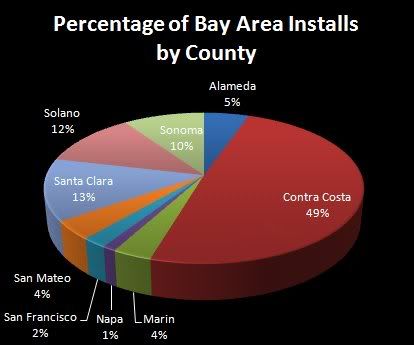
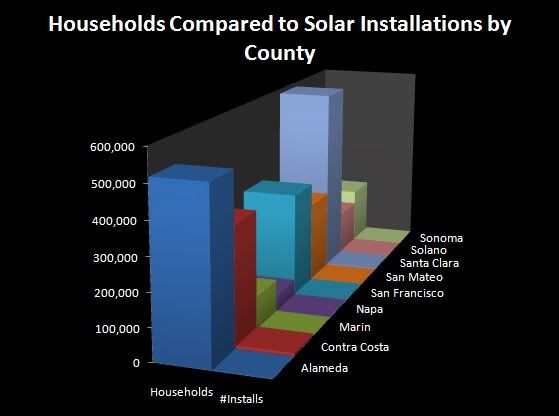
    As you can see from the image above, Contra Costa county accounts for just about half of the solar installs in the bay area over the past 3 years. The other counties pale in comparison. However, you can see from the chart below that there is a substantial way to go to penetrate the rest of the bay area market. While Contra Costa county does account for half of those installs, consider that that county is only about 2% saturated!

    Key Assumptions

    1. Size, Installed Price and # of installs numbers based on solar installs from 11/05 -1/08 –See

    http://www.energy.ca.gov/renewables/emergingrenewableslindex.html

    2. Population and Households data based on 2006 ACS Census estimates –See
    http://www.bayareacensus.ca.gov/
    for details

    3. Penetration calculated as % of households with solar.

    [Slashdot] [Digg] [Reddit] [del.icio.us] [Facebook] [Technorati] [Google] [StumbleUpon]