Green Car Dot Com – Just what it says

 Another very cool site:

http://www.greencar.com/

header_main.gif

California Modifies ZEV Mandate
By Green Car Journal EditorsIn 1996, The California Air Resources Board voted to give automakers a reprieve from implementation of the Zero Emission Vehicle mandate. If implemented on schedule in 1998, 5 percent of all cars offered for sale in the state by the seven largest automakers would have to emit zero tailpipe emissions. This represented the first time the regulatory agency had backed down in three decades of leading-edge emissions mitigation programs. Instead, an agreement with automakers required placing up to 3,750 advanced EVs on the road beginning in 1998. More…
CALSTART Showcase Electric Car
California aerospace companies applied their technology expertise in the CALSTART Showcase Electric Vehicle, which was used in an attempt to attract the attention, and the dollars, of auto companies looking to manufacture high-tech electric cars.
The Price of Electric Car Charging
In the mid-1990s as electric car designs were emerging, it became evident that a charging standards war was also brewing. GM had its elegant magnetic inductive charging paddle. Ford had its less costly conductive charger design. Neither appeared ready to back down.
Toyota RAV4 EV in Field Trials
The super-efficient Prius brought many new technologies to the market, but it didn’t do this alone. Substantial work conducted in Toyota’s RAV4 EV electric vehicle program years earlier paved the way with its many advanced electric drive technologies.
Nissan Electric Minivan Program
In the 1990s, Nissan leased a demonstration fleet of lithium-ion battery powered minivans with a 120 mile range. Why not a smaller and lighter electric car that could drive more than 200 miles between charges? A recognition that not everyone will drive small cars.
Honda to Lease EV Plus Electric Car
As Honda begins leasing its hydrogen FCX Clarity to fleets and consumers in limited numbers today, it’s interesting to look back at how this automaker handled the roll-out of a similar program with its EV Plus battery electric car back in the 1990s.
Driving The Precurser of the Toyota Prius Hybrid
Before the Prius was born, the Toyota Hybrid System was being developed in a nondescript Toyota sedan. Green Car editors drove this at Toyota’s Arizona proving grounds in 1997 and knew immediately that the electric drive field would change forever.
Tokyo R&D IZA Electric Car
Most news in the electric vehicle arena was made early on by the General Motors Impact prototype. As other automakers began picking up the pace in the race to build an electric car, activities were also taking place outside the automakers’ labs. One that stood out was Tokyo R&D’s IZA electric car.

Cities Bribe Residents To Adopt Good Environmental Practices

If every town and city in the country did this we could dig our way out of a deep environmental hole.

http://nctimes.com/articles/2007/12/28/news/nation/15_58_2112_27_07.txt

http://www.azcentral.com/news/articles/1227green-rebates1227-ON.html

This is an associated press article that was carried in at least the above newspapers.

U.S. cities encourage residents to go green with perks, cash


By BRIAN SKOLOFF________

THE ASSOCIATED PRESS

PARKLAND, Fla. – Free hy­brid-car parking. Cash rebates for installing solar panels.

Low-inter­est loans for  energy-saving home renovations. Money to tear up

desert lawns and replace them with drought-resistant landscap­ing.

Frustrated by what they see as insufficient action by state and federal

government, municipali­ties

 around the country are offer­ing financial incentives to get peo­ple

to go green.

“A lot of localities recognize they’re going to get a lot more done

using carrots and incentives

rather than regulatory means,” said Jason Hartke,

director of ad­vocacy for the U.S. Green Building Council.

In Parkland, where the motto is “Environmentally Proud,

” the city plans next year to begin

dispens­ing cash rebates to its 25,000 resi­dents for being more

environmen­tally friendly.

‘We will literally issue them a check,” said Vice Mayor Jared Moskowitz.

‘We’re sick of waiting

 for the federal government to do something, so we’ve got

to do what we can.”

Residents who install low-flow

toilets or shower heads will get $150. Replacing an old air condi­tioner

with a more energy-efficient one

 brings $100. Buying a hybrid car? An additional $200 cash back.

And the list goes on.

Based on an estimate of 1,000 residents participating in the re­bate

 program during the

first year, the city predicts it will cost up to $100,000.

“Could this bankrupt the city if the program grows by leaps and bounds?

” Moskowitz asked. “I can only wish

that so many residents want to go green that

that be­comes an issue.”

Many states already offer simi­lar rebates and incentives through

tax breaks, loans and perks such as

allowing hybrid-car drivers to use car pool lanes.

Utilities have long provided in­centives to buy energy-efficient a

ppliances, solar panels and toilets that use

 less water. The federal government, too,

offers tax incen­tives for purchases of many hybrid vehicles and e

nergy-saving prod­ucts.

Still, for many cities, it’s just not enough.

“In terms of waiting for the fed­eral government, we’ve waited

a long time, and frankly, we haven’t

gotten very much,” said Jared Blu-menfeld, director of

San Francis-

co’s Department of Environment. “And how do you change

some­one’s behavior? The simple an­swer is cash.”

Starting next year, San Francis­co will offer homeowners

 rebates of up to $5,000 for installing solar panels

if they use a local contrac­tor. Coupled

with state and feder­al incentives, that could cut in half the

$21,000 cost for an average household,

Blumenfeld said.

The city also will cover up to 90 percent of the costs of making

apartment buildings more energy-efficient,

 and will pay residents $150 to replace old

appliances.

The neighboring city of Berke­ley is financing the cost of

solar panels for homeowners who agree to 

 pay the money back through a 20-year property

tax assessment.

Nearby Marin County offers a $500 rebate to homeowners

who install solar systems.

Baltimore offers at least $2,000 toward closing costs for

people who buy new homes

close to where they work. It is called the “Live Near Your Work”

program.

“Just living near your job and taking transit or

walking to meet your daily needs

provides basical­ly the same environmental benefit as

buying a hybrid car,” said Amanda Eaken of the

 Natural Re­sources Defense Council.

Local Conservation Folks – google your own up today!

I rarely do retail outlets because there are 1000’s of them in any one state but a random google search turned up these 2:

http://energyimprovements.net/

phonenum.gif

graphic1a.gif

  • Reflects up to 97% of the radiant energy striking your home

  • Reduces electric and gas bills drastically year round
  • Increases the comfort level of your home
  • Is patterned after high-performance space-age technology used by N.A.S.A.
  • The least expensive energy improvement you can
    make to your home

  • Increases the efficiency of A/C and Heating unit
  • Maintenance free
  • Guaranteed for life
  • Never insulate again

The above is only a facsimile of the site but its headquarters are in Tyler Texas and the 800 telephone number should suffice for contact.

http://www.energyimprovements.com/

logo.gif

Welcome-

Energy Improvements, Inc. – energyimprovements@comcast.net
1-800-497-4293 – Route 106, PO Box 4085 – Concord, NH  03301

The funny thing to me is how they are battling over the domain name energyimprovements when they are very local contractors…some things never change. 

It’s ALIVE! – TGI(WB)F

What’s so weird about this bird? Well for one it is sacred. Yes it is the sacred Ibis of Iraq. But even weirder, it was thought to be extinct after Saddam Husein drained the southern swamps, their only known habitat.

http://www.birdersworld.com/brd/default.aspx?c=a&id=743

 sacred_ibis.jpg

While we are on the weird birds of Iraq travelogue:

http://www.lauraerickson.com/bird/Places/Iraq/IraqBirdsGallery.html

  Parakeet with large tumor.

 parakeet-iveschapman-200.jpg

Below is the more traditional Birds of Iraq.

mysterydanbritt-200.jpg

Finally, a quiz for points…which one is the male and which one is the female Iraqi Barn Owl?

barnowl-mhoyne-200.jpg

Danger Will Robinson Danger!

 http://news.yahoo.com/s/ap/20080110/ap_on_bi_ge/india_ultracheap_car 

or the original:

 http://hosted.ap.org/dynamic/stories/I/INDIA_ULTRACHEAP_CAR?SITE=AP&SECTION=HOME&TEMPLATE=DEFAULT&CTIME=2008-01-10-08-16-57

By GAVIN RABINOWITZ, Associated Press Writer 1 hour, 48 minutes ago

NEW DELHI – India‘s Tata Motors on Thursday unveiled the world’s cheapest car, bringing new mobility within the reach of tens of millions of people and nightmares to environmentalists, traffic engineers and safety advocates.

Company Chairman Ratan Tata, introducing the Nano — price tag $2,500 — during India’s main auto show, drove onto a stage in a white version of the tiny four-door subcompact, his head nearly scraping the roof.

With a snub nose and a sloping roof, it can fit five people — if they squeeze. And the basic version is spare: there’s no radio, no passenger-side mirror and only one windshield wiper. If you want air conditioning to cope with India’s brutal summers, you need to get the deluxe version.

But it’s cheap. The Nano’s closest competitor here is the Maruti 800, a four-door that sells for nearly twice as much.

Tata, however, is targeting people moving up from the lower ends of India’s transportation spectrum, where two-wheeled scooters selling for as little as $900 are often crammed with entire families.

While the price has created a buzz, critics say the Nano could lead to possibly millions more automobiles hitting already clogged Indian roads, adding to mounting air and noise pollution problems. Others have said Tata will have to sacrifice quality and safety standards to meet the target price.

The chairman, though, insists the car will meet safety standards and pollute even less than motorcycles, passing domestic and European emission standards and averaging about 50 miles per gallon. Girish Wagh, who headed the design team, said it had an oxidation catalytic convertor and it emitted 120 grams of carbon dioxide per kilometer.

Chief U.N. climate scientist Rajendra Pachauri, who shared last year’s Nobel Peace Prize, said last month that “I am having nightmares” about the prospect of the low-cost car.

“Dr. Pachauri need not have nightmares,” Ratan Tata said at the unveiling. “For us it’s a milestone and I hope we can make a contribution to the country.”

The basic model will sell for 100,000 rupees, but analysts estimate that customers could pay 20 percent to 30 percent more than that to cover taxes, delivery and other charges.

Tata has long promised that he’d create a 100,000-rupee car, a vow that was much-derided in the global industry but created a frenzy in India. On Thursday, nearly every media outlet in India focused on the live unveiling.

“A promise is a promise,” Tata told the crowd.

The car has seat belts, but no air bags. The Nano is about 10 feet long, 5 feet wide. The 2-cylinder petrol engine delivers 33 horsepower and a top speed of just over 60 mph.

Ford’s Model T, which debuted in 1909 for $825, had a 4-cylinder, 20 horsepower engine with a top speed of 45 mph. The Model T had fuel economy between 13 to 21 miles per gallon.

Tata has said they expect the car to revolutionize the auto industry, and analysts believe the Nano may force other manufacturers to lower their own pricing. French auto maker Renault SA and its Japanese partner, Nissan Motor Co., are trying to determine if they can sell a compact car for less than $3,000.

For now, the car will be sold only in India, but Tata eventually hopes to export it. The Nano could become the basis for other similar super-cheap models in developing markets around the world.

As rising middle class incomes drive demand for cars in India, automakers expect the ranks of car owners in the country to expand dramatically in coming years.

But for some, a huge influx of cars is a terrifying prospect of traffic jams at midnight, hours-long commutes and increasing pollution.

“If you’re talking about urban environment, it will cause serious problems,” said Jamie Leather, a transport specialist with the Asian Development Bank. “It’s a major concern.”

In 2005, Indian vehicles released 219 million tons of carbon dioxide, the leading greenhouse gas blamed for global warming.

By 2035, that number is projected to increase to 1,467 million tons, due largely to the expanding middle-class and the expected rise of low-cost cars, according to the Asian Development Bank.

“The cheaper and cheaper vehicles become, the quicker those pollution levels will increase,” Leather said.

New Software Models Buildings, Existing Technologies and NASA Data

 I know this is only exciting to the geeks and applied folks but…

Home

NRCan Launches

Latest Energy Software

Nusa Dua, Bali [RenewableEnergyAccess.com]

Natural Resources Canada (NRCan) has officially launched the latest version of RETScreen, a software tool developed by NRCan for renewable energy technologies.

“Renewable energy initiatives play a significant role in Canada’s fight against climate change, and RETScreen is helping to improve air quality and reduce greenhouse gas emissions in Canada and abroad.”

–Canadian Minister of The Environment John Baird

This version includes a full array of financially viable renewable power, heating and cooling technologies and energy-efficiency measures. The new energy-efficiency models are used for residential, commercial and institutional buildings, and for industrial facilities and processes. RETScreen now also features access to NASA’s global climate data.

“Today’s announcement demonstrates how Canada is developing and sharing knowledge that allows Canadians and the global community to make cleaner energy choices,” said Canadian Minister of The Environment John Baird. “Renewable energy initiatives play a significant role in Canada’s fight against climate change, and RETScreen is helping to improve air quality and reduce greenhouse gas emissions in Canada and abroad.”

More information about RETScreen and a copy of the software can be obtained at from RETScreen.com.

So If Photvoltaics Are Good Enough For The Military Why Not Us?

This is pretty impressive stuff:

http://www.skybuilt.com/

SkyBuilt Power® is the leading renewable energy systems integration company.

Use renewable energy, such as solar, wind, fuel cells, and micro-hydro power, with or without fuel-based systems, on or off the grid. Our power, engineering, business, and other experts help you to cut costs, increase reliability, lower maintenance and logistical tails; and gain environmental benefits.

Military and Intelligence Uses:
Lower cost, more reliable power
No logistical tail, no heat signature

Mobile Power Stations:
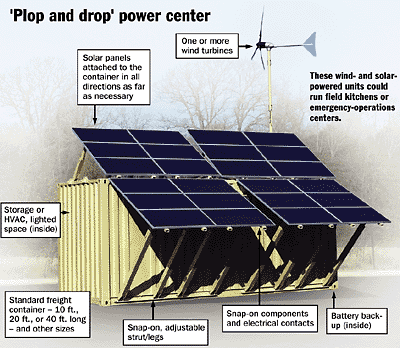
Containerized, rapidly deployed power, expandable from 0.5 kW to
150 kW or more; use the inside of the container for any purpose in the field
Power without fuel and virtually no maintenance

Commercial Applications:
Cell tower conversions to renewables
Geo Exchange systems to reduce HVAC costs

Homeland Security:
Disaster relief power, baseload or backup
Emergency Ops centers for first responders
Power for CBW and other sensors
Border control power

International:
Water pumping, desalinization and irrigation for Sustainable
Economic Development
Mobile clinics and health facilities
Self-contained, self-powered classrooms, offices

Contact us today.

4449 N. 38th Street, Arlington, VA 22207
Phone: 703.536.7866 | Toll-Free: 866.786.2845 | Fax: 703.536.7836


The Christian Science Monitor had this to say:

http://www.csmonitor.com/2005/1018/p02s01-sten.html


from the October 18, 2005 edition

The latest investor

in green energy – the CIA

Within hours, solar and wind energy units can be up and running in war or disaster zones.

| Correspondent of The Christian Science Monitor

What if you had a power unit that generated substantial electrical energy with no fuel? What if it were so rugged that you could parachute it out of an airplane? What if it were so easy to set up that two people could have it running in just a few hours?

Now there is such a device – built by a small Virginia start-up – and the federal government has taken notice.

SkyBuilt Power Inc. has begun building electricity-generating units fueled mostly by solar and wind energy. The units, which use a battery backup system when the sun is down and the wind is calm, are designed to run for years with little maintenance.

Depending upon its configuration, SkyBuilt’s Mobile Power Station (MPS) can generate up to 150 kilowatts of electricity, says David Muchow, the firm’s president and CEO. That’s enough to power an emergency operations center, an Army field kitchen, or a small medical facility.

Privately owned SkyBuilt now has a new investor – In-Q-Tel, a venture capital firm set up by the US Central Intelligence Agency. Skybuilt and In-Q-Tel will announce Tuesday that they have signed a strategic development agreement, including an investment in SkyBuilt.

In-Q-Tel’s support is a breakthrough for the small firm. (The “Q” in In-Q-Tel is a whimsical play on the movie character “Q” who supplies James Bond with nifty gadgets.) SkyBuilt provides innovative energy solutions with the potential to help meet a wide variety of critical government and commercial power needs, says Gilman Louie, In-Q-Tel president and CEO.

The power stations could have important uses for disaster relief, homeland security, military operations, intelligence work, and a variety of commercial applications. The units are not yet designed for use by homeowners.

Though it is not mentioned, SkyBuilt units would have obvious applications in places like Afghanistan and Iraq, where soldiers risk their lives over long supply lines to truck in fuel for generators.

After hurricane Katrina, SkyBuilt units could have been rushed to the scene and set up in hours, restoring power to hospitals, evacuee centers, police and fire departments, and cellphone towers.

 p2a.gif

Chris Robertson – Peak Sun Silicon

Another old friend has gotten into industrial applications for the production of Silicon:

http://peaksunsilicon.com/index.htm 

 Highest Conversion Efficiencies
If you want to offer your customers next-gen solar cell performance, Peak Sun Silicon delivers. Our electronic-grade polysilicon helps you achieve the highest conversion efficiencies in silicon solar cells.
Improved Net-Energy Payback Time
If you want to improve the net-energy payback time of the solar cells you manufacture, Peak Sun Silicon delivers. Our proprietary, fluidized-bed polysilicon manufacturing process uses about 80 percent less energy than conventional silicon processes. Because we use much less energy to make our silicon, you can more quickly pay back the manufacturing energy cost of your solar cells and modules.
Dependable and Experienced
If you want a dependable supply of polysilicon, Peak Sun Silicon delivers. Our management team has a proven track record in the semiconductor and solar energy fields. We’re committed to doing what it takes to deliver material to you on time and at a reasonable price to keep your factory running.The Result
More-productive solar-energy systems that meet the growing global energy demands of your customers — whether consumers or electric utilities — better and more cost effectively

ABOUT THE COMPANY

You’re in business to serve your customers by giving them the best solar cells you can make. To achieve your objectives, you need a reliable granular form of silicon; high-speed, high-volume factory production; less material waste; and lower-cost source materials.

Peak Sun Silicon is a new entry in the polysilicon market, where global demand continues to rise steadily. Peak Sun Silicon offers the competitive advantages that you’re looking for, such as steady supply, high conversion efficiency, and availability in a form that simplifies the manufacture of solar-electricity generating equipment.

The founder of Peak Sun Silicon offers nearly 30 years of experience in the semiconductor equipment and materials industry. And other leaders in the company are prominent in the solar-cell manufacturing and sustainable-development communities.

Ray Merry is Working On the Great Expo

 2 of CES’ old friend got ahold of me recently and are working on very exciting projects, a global renewable conference/exhibit and a cheap silicon process for solar generation. For Google purposes I am going to list them seperately, first up:

 http://www.greatexpo.org/

GREAT Expo 2009 is going to be an awe-inspiring, grandiose, never before experienced single point of contact for the world-class industrial-giants, and the emerging and underdeveloped countries as well as businesses and individuals interested in moving forward the renewable energies industry. GREAT EXPO 2009 is splendid, grand and majestic in nature, creating a one of a kind point of gathering that can only be invoked by the idea of an Energy-Park in which all the latest technologies, heavy equipment and machinery of all nine sectors of renewable energy and Energy Efficiency will be showcased, including:

Agro Energy, Bio Energy, Hydro Energy, Hydrogen Fuels, Ocean Power, Geothermal Energy, Solar Energy, Wind Power, and Energy Conservation and Efficiency.

We expect equipment such as wind turbines and towers, dry/wet mill processing equipment, hydrogen and ethanol powered vehicles from the top distinguished firms (Le Mans, IndyCar Series, Toyota, BMW, GM, Honda, Tesla Motors), hydrogen powered motorcycles, hybrid watercraft, solar manufacturing equipment, solar energy innovations and much more to garrison at the Energy Park. It is in this sense that GREAT EXPO 2009 brings the software and hardware of the renewable energies industry under one roof.

GREAT EXPO 2009 brings, in its summit, all the programs and operating information useful to the renewable energies industry. The expo element of GREAT EXPO 2009 brings all the tools, machinery and physical components used in the renewable energies needed for an earnest and industrious effort towards a sustainable world.

GREAT EXPO 2009, to be held in Washington in Spring 2009, gathers the most prominent players in the renewable energies industry It is expected to attract over 45,000 professional visitors and political delegations, and 1,400 exhibitors from 180 countries. Visitors will represent all relevant parts of the decision-making chain – from engineers, purchasers, and analysts to political representatives and board members.

This is the only event that covers key aspects of all eight renewable energies market and Energy Efficiency, giving unparalleled access to business contacts and unique networking opportunities.

Do not miss the opportunity to present, exhibit or network at the world’s premier renewable energies and advanced technologies event.