Zenn, EEStor, and Venture Capitalist Kleiner Perkins Cauflield and Byers All Bet ON Patent #7,033,406

Invention suggests car

-energy revolution

By GRANT SLATER

THE ASSOCIATED PRESS

AUSTIN, Texas — Millions of inventions pass quietly through the U.S. patent office each

year. Patent No. 7,033,406 did, too, until energy insiders spotted six words in the filing

that sounded like a death knell for the internal combustion engine.An Austin-based

startup called EEStor promised “tech­nologies for replacement of electrochemical

batteries,” meaning a motorist could plug in a car for five minutes and drive 500 miles

roundtrip be­tween Dallas and Houston without gasoline.

“THE ACHILLES’ HEEL to the electric car industry has

 been energy storage. By all rights, this would make

internal combustion engines unnecessary.”

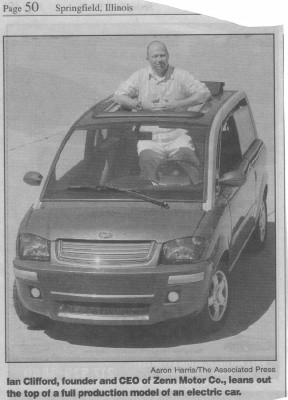
IAN CLIFFORD,

CHIEF EXECUTIVE OF

ZENN MOTOR CO., WHICH

LICENSED THE INVENTION

By contrast, some plug-in hybrids on the horizon would require motorists to

charge their cars in a wall outlet overnight and promise only 50 miles of

gasoline-free com­mute. And the popular hybrids on the road today still depend

heavily on fossil fuels. “It’s a paradigm shift,” said Ian Clifford,

chief executive of Toronto-based ZENN Motor Co., which has licensed EEStor’s

invention. “The Achilles’ heel to the electric car industry has been energy

 stor­age. By all rights, this would make internal combustion en­gines unnecessary.”


Clifford’s company bought rights to EEStor’s technology in August 2005

and expects EEStor to start shipping the battery replacement later this

year for use in ZENN Motor’s short-range, low-speed vehi­cles. The technology

also could help invigorate the renewable-energy sector by providing

ef­ficient, lightning-fast storage for solar power, or, on a small scale, a flash-charge

 for cell phones and laptops. Skeptics, though, fear the claims stretch

 the bounds of existing technology to the point of alchemy. “We’ve been

trying to make this type of thing for 20 years, and no one has

been able to do it,” said Robert Hebner, direc­tor of the University of

Texas Center for Electromechanics. “Depending on who you be­lieve, they’re

at or beyond the limit of what is possible. “EEStor’s secret ingredient is

a material sandwiched be­tween thousands of wafer-thin metal sheets,

like a series of foil-and-paper gum wrappers stacked on top of each other.

INVENTION

• From page 47

Charged particles stick to the metal sheets and move quickly across EEStor’s

proprietary materi­al. The result is an ultracapacitor, a battery-like device that

stores and releases energy quickly. Batteries rely on chemical reac­tions to store

energy but can take hours to charge and release energy. The simplest

capacitors found in computers and radios hold less en­ergy but can charge or

 discharge in­stantly. Ultracapacitors take the best of both, stacking capacitors

to increase capacity while maintaining the speed of simple capacitors. Hebner said

vehicles require bursts of energy to accelerate, a task better suited for

capacitors than batteries. But Hebner said nothing close to EEStor’s claim

exists today. For years, EEStor has tried to fly beneath the radar in the competitive

industry for alternative energy, con­tent with a phone-book listing and a handful of

cryptic press releases. Yet the speculation and skepti­cism have

continued, fueled by the company’s original assertion of making batteries obsolete

 — a claim that still resonates loudly for a com­pany that rarely speaks,

including declining an interview with The As­sociated Press.

The deal with ZENN Motor and a $3 million investment by the ven­ture capital

group Kleiner Perkins Caufield & Byers, which made big-payoff early bets

on companies like Google Inc. and Amazon.com Inc., hint that EEStor may be

on the edge of a breakthrough technology, a “game changer” as Clifford put it.

ZENN Motor’s public reports show that it so far has invested $3.8 million and

 has promised another $1.2 million if the ultracapacitor company meets

a third-party testing standard and delivers a product Clifford said his

company con­sulted experts and did a “tremen­dous amount of due diligence” on

EEStor’s innovation. EEStor’s founders have a track record. Richard D. Weir

and Carl Nelson worked on disk-storage technology at IBM Corp. in the

1990s before forming EEStor in 2001. The two have acquired dozens of

patents in two decades. Neil Dikeman of Jane Capital Partners, an investor in

clean tech­nologies, said the nearly $7 million investment in EEStor pales

com­pared with other energy storage en­deavors, where investment has av­eraged

$50 million to $100 million. Yet curiosity is unusually high, Dikeman said, thanks

to the invest­ment by a prominent venture capi­tal group and EEStor’s

secretive na­ture. “The EEStor claims are around a process that would be

quite revolu­tionary if they can make it work,” Dikeman said. Previous attempts to

improve ultracapacitors have focused on im­proving the metal sheets by increas­ing

the surface area where charges can attach. EEStor is instead creating better nonconductive

material for use be­tween the metal sheets, using a chemical compound called barium

titanate. The question  is whether the company can mass-produce it. ZENN Motor

pays EEStor for passing milestones in the produc­tion process, and chemical

re­searchers say the strength and func­tionality of this material is the only thing

standing between EEStor and the holy grail of energy-storage technology.

Joseph Perry and the other re­searchers he oversees at Georgia Tech say

 EEstor seems to be claim­ing a 400-fold improvement of a ca­pacitor’s retention

ability, yet in­creasing that ability often results in decreased strength of the materials.

“They’re not saying a lot about how they’re making these things,” Perry said. 
electric-car.jpg

okokokokok I Eat Crow and Its Not Even Weird Bird Friday

Yes it is true sometimes I am a jerk. BUT I am not an unrepentant jerk. I apologize to the brilliant journalist minds at State Journal Register! Not only did they win 9 awards in competition against other State of Illinois newspapers. They also ran my letter in toto even though it went over their 300 word limit. (hangs head and toes the dirt) I was wrong about youse guys. Sorry.

Springfield Based State Journal Register Sucks

Well maybe that is an over reaction but I sent them the following Letter to the Editor, and the conservative twirps did not even acknowledge that they received it. Since the new owners took over they have started running op eds by Walter “the madman” Williams from George Mason (alleged) University, that is about as right wing as you can get.

Editor

State Journal Register

One Copley Plaza

Springfield, IL 62701


Emailed – 9/17/07

Dear Editor:

Your Stanford Levin op-ed piece was incredibly deceptive and disingenuous. He says, “Let the Markets decide” about whether we burn ethanol or foreign produced oil as gasoline. Those self same markets are killing us and killing our country. The reason for this is that the markets are wedded to the internal combustion engine that simply BURNS up resources. We have done just about all the burning that we can do in this country.


How nice it would have been, if during his tenure on the ICC from 1984-86, he had advocated a move away from burning coal in power plants and increased efficiency trucks. Instead he continued the passive dependence on coal and gasoline, which has led us to global warming. If he had shown courage 23 years ago and demanded stringent efficiencies in the coal fired power plants that he regulated and a shift to power plants that burn natural gas he may have done some good. If he insisted that those utility companies invest in wind and solar portfolios then Illinois would lead the United States in those power sources but instead we have broken down, and leaking Nuclear power plants.


Yet Dr. Levin wants to trot out the old Ronald Reagan saw one more time and say, “Let the markets decide”. Deregulation has been nothing short of an economic disaster for the middle and lower classes. But, that is nothing compared to the environmental disaster that this country has been exposed to as a result. The North Pole is melting and Dr. Levin wants to make some telling point about which fuel source we should burn, biodiesal or gasoline. BAAAA (wrong answer) The answer is we should not be burning either and the MARKET will never give us that answer. Are we to wait another 23 years, while the captains of industry are driving huge ocean going vessels through their “Northwest Passage” and Russia is drilling on the artic floor before we blow the whistle and end the play?


Sorry Dr. Levin, but as you should have realized in 1984 the markets require hard regulation before they ever respond. The internal combustion engine is obsolete and you could have helped us move away from it. You did not. Join us at www.censys.org or call 629-7031. Community Energy Systems plans on helping Illinois move to a non-Burning future.


Doug Nicodemus

948 e. adams st.

riverton, IL  62561

629-7031

dougnic55@yahoo.com

Since Interstellar Space Travel Is Impossible What Would Have Been the Impact Had Science Fiction Not Lied.

Why was Asimov so mad?


The thing that always impressed me about the essay that I can’t find (see previous blogs) was its tone. I have read many Asimov works (which I am assuming was a condensation of a longer essay in the book, The Relativity of Wrong, see previous blog) and he never ever appeared angry. In this essay he was angry, accusatory and attackive! How did he go from a 1984 essay discussed earlier where he blithely dismissed both time travel and faster than light interstellar travel (as impossible) as mere conventions to seeing those same concepts as dangerous?


Was it because he was ill with AIDS and knew he would soon die? That would explain animus in anyone I suppose. Asimov had discussed death before though and he seemed comfortable with it.


I think it was more than that. I think he thought space travel would die and that he was in part responsible for that death. Paraphrase begins {: He concludes the essay by saying that he fears that when NASA fails to come up with even routine planetary travel in the next 30 or 40 years that NASA which is expensive will be abandoned.:} paraphrase ends. But I think it was bit more emotional for him then that because he probably asked himself some tough questions and saw what the real answers were for both his craft (science fiction writing), human space exploration, and maybe even how we treat the planet.


What would Science Fiction have looked like without interstellar space travel? One of his firm beliefs was that early science fiction always stuck pretty much to the possible. The writers were keen on new technology and knew what was possible. THAT was the magic of it really? Artie Clark would write about satellites and BOOM 10 or 20 years later they were circling the globe. Many writers talked about travel to the moon and 60 or 70 years after the first story we were there. At some point that became too restrictive to the writers of the 60’s. They yearned to do more. They wanted to make science fiction “real” literature. To bring grand stories to the silver screen.


So you say, “So What”? Well imagine what the cultural world would be like if every science fiction work had begun with the disclaimer (imagine the Star Wars intro screen “rolling out” this way) The story you are about to see is IMPOSSIBLE. Humans will never be able to travel between the Stars and even planetary travel will be really really expensive and dangerous. Planetary travel may not even be routinely possible 400 years from now! Then IN A GLAXAY A LONG WAYS FROM HERE IN THE DISTANT FUTURE THERE WAS A BAND WARRIORS FIGHTING AGAINST TYRANNY. Or whatever the Star Wars intro was. I think that that might have slowed down our mindless rush into space. But lets take it a step farther. Lets say to be a science fiction writer you had to take a Pledge. “I Doug Nicodemus promised to write science fiction that uses technology available to humans only in the next 60 or 70 years” And what if you were thrown out of science fiction writing if you violated that pledge! No publisher would publish you.


Well first off the idea of Aliens would be radically altered. Not disappearing mind you because you could posit “foreign worlds” as long as you gave star coordinates for it. They could have all kinds of weird characteristics and they could even be zipping around their very different solar system. But no more than that.


Second there would be no aliens visiting the earth. There would be no UFO’s and every science fiction writer would laugh at people who claimed to have seen them as the lunatics that they probably are. Aliens can’t get here…end of story.


Some people have even told me that Science Fiction would have simply died out. I don’t think so. It most certainly would have had to get a lot cleverer. And might have made science a bit cleverer as well. Just as an example I could imagine a story in which we could use things that go the speed of light like really bright lights or radio wave to try to communicate with other planets. Just AIM and Fire. I mean really, SETI is nice and all but it doesn’t make much sense for us to just sit around and listen to broad frequencies for some “sound”. Under a premise like that you could weave an Evangeline like story where this guy and this gal establish contact fall in love but they will never be able to touch each other. There are tons of stories that could have been written about conquering Mars and the other planets. Which would have led to more and open discussions about different technologies that could have got us there. What our living quarters would look like and why we were there in the first place. Gold? Platinum? Fuels? I am no science fiction writer, buts it the people in the story that any good writing is about.


 Neil deGrasse Tyson has a thought or two on the matter. When I pause and reflect on our expanding universe, with its galaxies hurtling away from one another, embedded within the ever-stretching, four-dimensional fabric of space and time, sometimes I forget that uncounted people walk this Earth without food or shelter, and that children are disproportionately represented among them.

http://research.amnh.org/~tyson/18magazines_cosmic.php

What has the impact of this “impossible dream” of interstellar space travel been on Environmentalism? Well if we are going to get a NEW planet then we don’t have to take care of this one. If we really are inhabitants of this little tiny cosmic island, isolated from the universe, except for what we can observe of it, as Tyson has said. And that had been rammed home over and over again, then maybe we would treat our ONLY planet EVER a whole lot better. Did Asimov realize that? I doubt it but it is a burden that we who are opposed to burning will have to over come. And soon.


ON the other hand maybe there was a reason GOD set the speed limit for those with so little understanding at 186,000 miles a second. So we cannot do to the universe what we have done to the Earth and may do to the solar system.

Isaac Aimov and the Relativety of Wrong (Science Fiction Lies continued)

In “The Relativety of Wrong” he argues in one essay that it’s easy to see that there are DEGREES of being wrong. He uses a very simple example to make his point. There are two historical views of the Earth. One is that it is flat, and one is that it is round. Neither is right. The Earth is a spheroid. Kinda bulgey in the middle and tapered at the top. But which one is less wrong? Obviously, that the Earth is round is, “pretty nearly true”.

Apparently, in the same volume of essays he had pretty much come to the same conclusion about space travel as depicted in much of science fiction, that faster than light travel was as wrong as the flat Earth explanation of the shape of the planet. In other words there are people who say we should not be messing around with manned space travel because it produces no useful results. They argue that we should be using sophisticated and cheap probes to explore the solar system and beyond. That we as a people should be concentrating on making life better on this planet instead.

The science fiction oriented people argue that we must continued with manned exploration. Moving us further out in the colonization of the solar system, while developing ever new and new space craft. In the process many believe we will find away around the “Speed of Light” problem and launch for the stars. Their first goal is to replace the Space Shuttle, set up building operations on the moon and get ready for a try at Mars.

Asimov flatly asserts in an article in 1987 that we must spend 100 years developing a space infrastructure and space travelers who are aclimated to zero G’s on the moon.

Their most ambitious project? A manned mission to Mars with a two-nation crew, a collaboratively built ship, and the goal of planting both the Stars and Stripes and the Hammer and Sickle on the surface of the Red Planet.

Understandably, the idea had imme­diate appeal. Who could argue with an undertaking that would double the talent pool of both nations’ space programs, halve the costs, and, not incidentally, speed the recent thaw between Moscow and Washington?

But hold on. The proposal does have a flaw. It’s possible that the first people on Mars should be neither Americans nor Soviets. Indeed, it’s possible they shouldn’t be people from Earth at all. Rather they should be moon people. Let me explain.

HE GOES ON TO SAY THAT ON THE MOON WE WOULD BUILD AS SOLAR SYSTEM VEHICLE THAT WOULD BE REUSABLE, AND TECHNOLGY AND THE PHYSIQUE FOR LIVING IN SPACE.

What is needed instead is not a one­time sprint to a nearby planet, but a slow, patient expansion away from Earth; a long-term program—perhaps taking a century to complete—that would equip us not just for a single interplanetaryjoyride but for the coordinated explore-‘ tion of the deep solar system.

The first thing a long-term Soviet-American space program would need, of course, would be a base from which to launch its vessels. We have any number of sites on Earth, but our planet is nol truly satisfactory. Escape velocity from Earth is 7 miles per second; that makes lift-off difficult. There are only foui bodies in the solar system—the sun. Jupiter, Saturn, and Neptune—with a tighter gravitational grip and a highei escape velocity. Then, too, Earth has an atmosphere and weather. Storms in­hibit launches, and even clear air offers resistance.

What we need is a place that is alto­gether otherworldly, a celestial bodi that,  though sizable,  is  lighter thai Earth, with a lower escape velocity, ll would also be convenient if that bod\ had no atmosphere. As a kindly fate has it, our closest astronomical neighbor ii ideally suited for this. It is the moon which has a diameter of 2,160 miles, at escape velocity of but 1.5 miles pa second, and barely a wisp of atmo sphere.   Less  than a quarter-milliot miles away, it can be reached

with pres ent rockets in just three days. It’s asi we’d spent decades launching our ship from some stormy, rock-strewn pon only to discover that all along there: been a smooth-as-glass harbor just a fev miles down the cosmic coast.

Fine. So let’s dust off the old moot ships, fly our engineers to the Sea t Tranquility, and build ourselves a luw Canaveral.

HE BELIEVES  THAT  THE FOLLOWING PROCESS WOULD LEAVE US PREPARED TO EXPLORE AND COLONIZE THE SOLAR SYSTEM OVER THE NEXT 1000 YEARS. REPEAT OVER 1000 YEARS!

Once we reached the moon, there would be no limit to the ways in which we could use its resources. The moon is a world with a surface area equal to that of North and South America put together. From its raw materials we can get a large variety of metals, concrete, glass, and oxygen. In fact, a moon base that in­cluded mining stations would supply everything we would need for construc­tion except water and the light elements: carbon, nitrogen, and hydrogen. These would come from Earth.

Using the moon as our source of raw materials and Earth as a reservoir of talent and technology, the space be­tween Earth and the moon could be filled with any number of support structures —solar energy stations, nuclear energy stations, observatories, and laborato­ries. Even some of Earth’s industrial plants could be put into orbit, to take advantage of the unusual properties of space (vacuum, microgravity, extreme temperatures) that facilitate manufac-

20     DISCOVER • JANUARY • 1988


 turing. What’s more, the waste products the factories put out could be much better disposed of in the vastness of space than in Earth’s fragile and finite biosphere. To service and populate all these facilities, space settlements— each holding thousands of people— could be built, designed to mirror Earth’s environment as closely as possible.

Ideally this extension of the human range should be global, operated not just by the United States and the Soviet Union but by the world at large. In fact, as the moon and the space settlements became more populous, international control could be loosened, and the new worlds could become regional self-gov­erning units of an Earth-Space Union.

It may take five generations or more to flesh out such a system, but only then would we be ready to make the most of the next major step: a trip to Mars.

When that project finally did get un­der way, the best thing for the Earth people to do would be to step back and leave it to the space people to make the journey. Space settlers would be much more accustomed to the idea of space flight, much more accustomed to low and varying gravity, much more accus­tomed to living inside a world rather then on it.

The moon couldbecome o new Canaveral, a spring board to the planets.

They would be much more aware of the need for resource control and tight recycling of such necessities as air and water. When the colonists reached Mars, they would find it rich in the light ele­ments. Using these along with the re­sources available from the moon, the Mars settlers, moon settlers, and space settlers could soon become independent of Earth for raw materials. Such economic independence would help speed the next phase of expansion —out to the asteroid belt where hun­dreds of thousands of small worlds exist, many of which could be carved into settlements or used for further mining operations. And these asteroid settle­ments—once equipped with advanced propulsive mechanisms operating like giant outboard motors—might them­selves be steered into the vast expanses of the outer solar system or beyond the solar system altogether. No one making these long trips would be conscious of. having left home, for they would be taking home along with them. The process of migration and settlement could stretch out over millennia, but what’s the rush? Rather than racing into a symbolic, onetime visit to Mars! We should perhaps contemplate this  slow exploration of the galaxy, by a process very much like the dispersal of  dandelion seeds by a helpful wind.


So he is basically saying that both the stay-at-homers and the go-far-and-fast crowds are both wrong. But in that telling essay that I can not find he believes the far-and-fast crowd are wrong and fraudulant as well. In other words really really wrong. More on that in the last blog on the subject I hope.

Science Fiction Continues To Lie or Why Was Issac Asimov Wrong And Then Right?

Demolisher of myths / Review of ‘The Relativity of Wrong’ By Isaac Asimov

  • 08 April 1989
  • From New Scientist Print Edition. Subscribe and get 4 free issues.
  • JOHN EMSLEY

Asimov also disposes of another popular myth – that one day we will journey to the stars. Here he is tampering with something that might have been better left alone. He quietly knifes the idea in the back, and thereby murders much popular culture on which today’s young people are raised. Space travel is possible between the planets of the Solar System, but that is all. Whatever probe we launch from planet Earth into the cosmos will get nowhere. It will slowly come to rest between here and the next star. A manned spacecraft would suffer the same fate.

Only if we use antimatter as a fuel can we make a return trip to the nearest star, and that form of energy is likely to remain forever beyond our grasp. In any case, the effort would never justify the visit; our intrepid voyagers, or their descendants, would not arrive back before AD 50 000.

Because we can never visit another star, so we can never be visited by aliens from another Solar System. Another chunk of popular science folklore bites the dust. Space travel is a meaningless phrase. Star Wars, Star Trek, and a lot of science fiction suddenly seems merely silly. Asimov you’re a spoilsport!

http://www.newscientist.com/article/mg12216594.200.html

The above is not the actual essay where Asimov accuses certain science fiction writers like Roddenberry and George Lucas to only pick on some of the best writers of thousands who have used the device of “suspension of expectations” to peddle their tales involving rapid travel through space. Though the writers vary in their ease of such travel. Many argued that such travel will come with travail, like spice addiction in the Navigators in Dune, or being frozen in Aliens, or even having everyone you know die because it takes so long. BUT still you could DO it. In others all you had to say was, “Make it so” or “Engage” and off you went to distant worlds filled with interesting, sometimes intellegent, sometimes hostile Life Forms

Why is this interesting?

Well one the original essay is in a book where Asimov argues that there are different degrees of being wrong.

Two he is pointing out that the space travel idiom was not just wrong but really really wrong.

Three that myth of space travel has an immense impact on our culture.

BUT, most important for me, it speaks to why the “environmental movement” still struggles to try to save the planet when it is pretty much on the way out of existence right now. Amazingly enough just 10 years earlier Asimov was actually expousing the opposite view. He said then:

Faster than Light 

One other impossibility that equals it  (time travel..note added) as a science fiction essential is “superluminal” (“faster than light”) travel. Without superluminal travel, sci­ence fiction writers are confined to the Solar system. It is only routine superluminality that makes galactic empires, and such things as interstellar warfare, really practical.

There is this difference between time travel and superluminal travel, however. I imagine that most people are willing to think of time travel as essentially fantasy, but to consider superluminal travel as fantasy seems to annoy, and even enrage, a large fraction of the s.f. readership. Why isn’t superluminal travel possible? What is so magic about the speed of light? Surely, if you keep accelerating long enough and hard enough, you are bound to “break the light barrier.”

AND WHAT FOLLOWS IS AN ELIGANT MATHMATICAL PROOF THAT YOU CAN NOT GO FASTER THAN THE SPEED OF LIGHT. AND HE CONCLUDES THE MATHMATICAL DISCUSSION BY SAYING:

Please note, however, that the mass has been increasing at a faster and faster rate as the speed increases.

The more mass an object has, the less it can be made to accelerate in response to a given force. A force applied to an object moving at 260,000 kilometers per second (and therefore with twice its rest mass) will produce only half the acceleration that that force would have produced if it had been applied to the same object when it was at rest. As an object speeds up under a constant force, its mass increases ever more rapidly and its speed increases ever more slowly. The mass increase predominates, so that momentum and kinetic energy continue to increase more rapidly even though speed increases more slowly.

By the time we reach a speed of 290,000 kilometers per second (97 percent of the speed of light), the mass of the moving body is 3.892 kilograms, almost four times the original mass. At 295,000 kilometers per second (98.3 percent of the speed of light—if that is taken at the slightly incorrect 300,000 kilometers per second figure), 5.52 kilograms; at 299,000 kilometers per second (99.7 percent of the speed of light), 12.22 kilograms; at 299,999 kilometers per second (99.9997 percent of the speed of light) 383.5 kilograms.

At the speed of light itself, if that could be reached, the mass would be infinite—as would be the momentum and the kinetic energy.

A faster speed is impossible because neither mass, momentum, nor ki­netic energy can be more than infinite. Besides, at infinite mass, no force, however great, can produce any acceleration, however small, so the speed cannot increase. —So the speed of light is the limit that cannot be passed.

AND YET HE CONCLUDES THE PIECE BY SAYING:

Ways of evading that limit (tachyons, black holes, hyper-space) have been suggested, but all involve phenomena concerning which we 

can only speculate, and in favor of which there is no observational evidence whatever. Nevertheless, superluminal travel cannot and will not be abandoned in science fiction. Certainly, I will never abandon it.

SORT OF ENDING WITH A TEHEE TEHEE AS HE DID MANY OF HIS ESSAYS.

The Lies of Science Fiction

In 1989, or there abouts, I read an essay in Discover Magazine by Isaac Asimov titled Science Fiction has Created False Expectations. Or something like that. I am embarrassed that I cannot find it but I have tried and (to recreate Dave Barry I swear I am not making this up) I couldn’t find it. If I had the damn essay I could just (copy) BLATT! it up here or (cut) BAMM! a paragraph here and move on like Batman. But I don’t so I am going to have to paraphrase it here – really Asimov was a better writer – and keep looking.


Paraphrase begins{: He said that the older science fiction writers were deeply tied to emerging technology and the laws of physics (Clark, Heinlen, etc.) He argued that many of the modern science fiction writers were using a plot device, “the suspension of expectations”; to promise things in print that science would never be able to produce. His big complaint was space travel over large areas in short time periods with relative ease. (Star Trek, you name it, etc.) He argued that faster than the speed of light wasn’t possible. That just getting to Mars was going to be dangerous, expensive and slow. He concluded that such “science fiction” writing was fraud and had raised expectations so high in what we call the boomer generation that it would damage real space exploration for generations. :} Paraphrase ends


When I first read that, and I will find it, I thought well this is just an old guy fulminating about the younger generation of writers embellishing on themes that he himself had laid down. But the essay stuck with me. When we struggled to build a space station, I revisited the essay in my mind a 2nd time and thought well, in a way he was right but FRAUD? And as the years passed I thought well this is getting “righter”. We are after all still not comfortable settling the Moon and Mars is not even an option. As one chunk of science fiction morphed into cowboy movies like Star Wars and another chuck of science fiction took a bent towards desperate fantasy like Deep Space 9 where wormholes are actually posited as a means of travel I began to get his drift. But it was not until I thought (a 3rd reconsideration) about what his essay meant for the environment that I began to understand his harsh criticism. I mean the charge FRAUD is usually reserved for those who make things while claiming to be telling the truth. Like if you claim you have performed cold fusion in a test tube. That seemed to me way over the top at the time but now I think I understand

.

I always understood why people from the 30’s to the 50’s had a hard time accepting the idea of stewardship for the Earth as mandatory. There were so few of them and they were raised to burn just about everything they could get their hands on. One could just move on to another unpolluted space, there were no real immediate consequences. Towards the end of their lives many of them told me it was up to there children and grandchildren to “solves these problems” through new technology undreamed of in their day. But I never understood why so many people born in the 60’s through the 90’s did not understand that stewardship of the Earth was our Number One Job. I understand that a lot of the green house gasses are odorless and tasteless but when the Rhine caught on fire and Los Angeles’ air turned orange you don’t have to be an “environmentalist” to think that something is wrong.


Why hadn’t people got the idea that this little planet all alone in a solar system on the outer edge of a minor galaxy far from the center of the universe was to be cherished and enriched? It was because the sad truth that Earth is all we got was too threatening to our current economic systems. If this truth was ever realized by the people here now all that manufacturing and assembly of stuff would become irrelevant. But also the idea that we would “be out of here” to other planets fit right in to the tribal expectations that lead to us burning things in the first place.

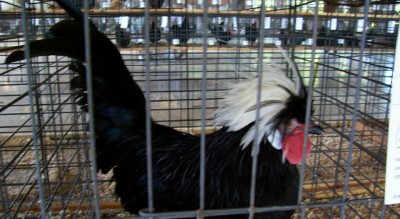
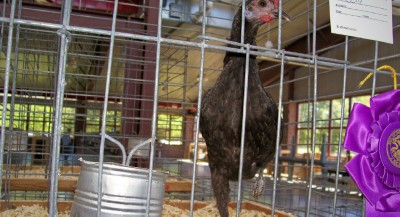
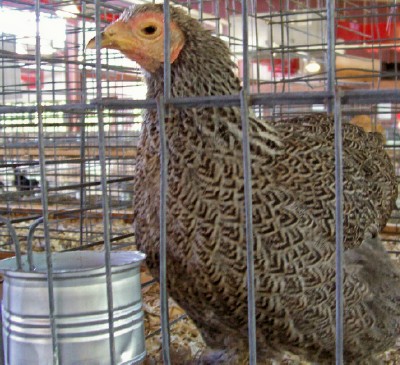
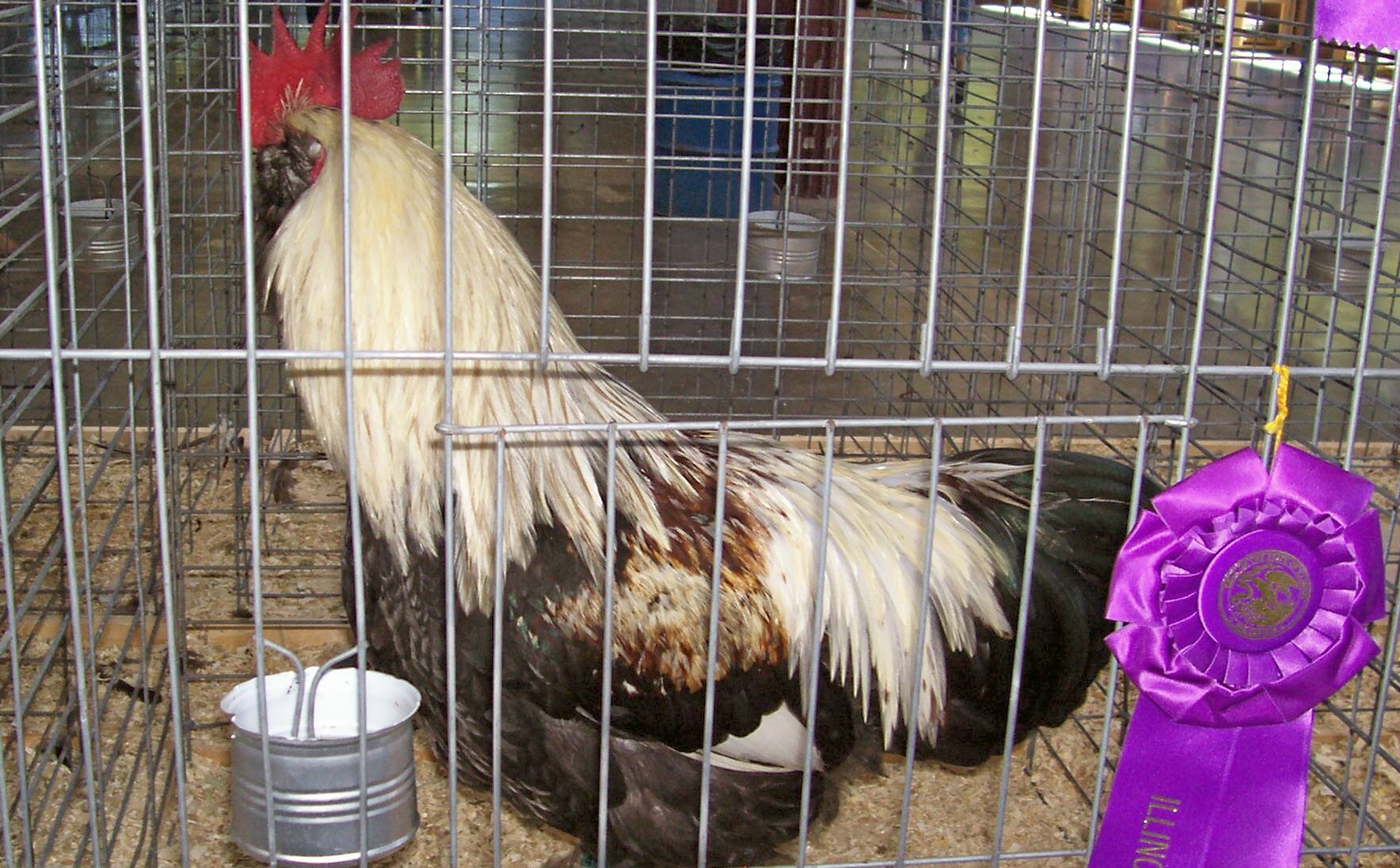
Weird Bird Friday – The State Fair

I know its totally weird that I spend so much time on the Illinois State Fair, but if I don’t get my corndog, my lemon shakeup, my french fries with the skins on doused in malt and our trip to the Chicken show at the Orr building, I can get cranky. Yes we tour the sheep barn too, but don’t expect any Weird Sheep Friday anytime soon.

Animal lovers and PETA people close your eyes because this is 2000-3000 Birds all in once place in …how can I say it…ah CAGES.

And yes John and Susan we go to the Chicken show every year…

First up the prize winning Turkey (no kidding)!

 weirdbird-1.jpg

Then the prize winning Duck (quack quack) it really is a loud building to visit.

 weirdbird21.jpg

Showing some cute duck ass.

Mic Jagger the Chicken.

 weirdbird31.jpg

The dancing nearly naked chicken.

weirdbird4.jpg

 And This BAD BOY in all his glory.

 weirdbird51.jpg

Those little things sticking out of the water bowel – yea they are chicken straws and who would break the last one?

Finally the big question -would you eat this angry bird? No probably not. Eggs – no way!

weirdbird6.jpg

To the seminal question “Do chickens have lips”? Oddly the technical answer is yes! Look very very closely.

What Would Happen If All The Oil Workers Went On Strike?

Like in the previous entry what if all of the Oil Workers followed the Coal Miners and stopped Work. What if they demanded to be retrained as Solar Workers instead. They could make solar panels, or other products that would supply energy but not harm the globe. What would happen then? I ask you to imagine such a world not because I think it is likely to happen, but because it is the economic leap that we shall have to make sooner or later.